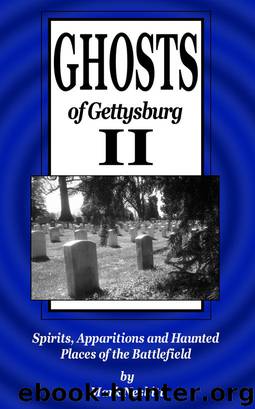
Ghosts of Gettysburg II by Mark Nesbitt
Author:Mark Nesbitt
Language: eng
Format: epub
Tags: spirits, paranormal, civil war, supernatural, ghost stories, gettysburg, hauntings, haunted houses, haunted battlefields, haunted buildings, supernatural haunting ghost, ghost adventures, supernatural events, ghost guide, mark nesbitt, ghosts of gettysburg, hauntings life after death
Publisher: Second Chance Publications
***************
Chapter 10: Off-Off Broadway
There are more things in heaven and earth Horatio,
Than are dreamt of in your philosophy.
—William Shakespeare, Hamlet, Act I, Scene v.
Most people who visit Gettysburg are under a misconception as to where “The Battlefield” actually is. The monuments and markers for the most part, delineate the battlelines of the two armies. They stretch down the two major ridges once splashed with human blood—Cemetery and Seminary Ridges—and in a wavy arc a mile and a quarter west and north of town where fighting occurred on the first day. The United States Government owns much of the land, or at least the right of way where the monuments stand, along these major battlelines. Many visitors to Gettysburg ask the question, “Where’s the battlefield?” expecting, perhaps, a fenced-in area they can see with one sweep of the eye.
While the government owns or has right of way to some 6,000 acres, “The Battlefield”-—where close to 175,000 men fought, maneuvered, were wounded, bled and died—must cover several hundred square miles. Nearly every road from Chambersburg to Carlisle to Harrisburg to York was crossed and criss-crossed by cavalry, and infantry marched a good bit of that area as well. The web of roads between the small towns were all covered too. You can hardly drive along a road in Adams County, York County, Franklin County and Cumberland County that, at one time, wasn’t used by the two armies. Fights and skirmishes associated with the world famous Battle of Gettysburg occurred in towns with hardly recognizable names like Fairfield and Hunterstown, Carlisle and Wrightsville and Hanover, Monterey Gap and Zora and Cashtown.
So, the answer to the question, “Where’s the battlefield?” is: you’re standing on it. Whether you’re in a modern motel lobby or sitting in a Gettysburg resident’s fancy dining room on Broadway, you’re on a part of the Gettysburg Battlefield, probably in the same space (but at a different time, of course,) where men struggled, or charged, or retreated, or perhaps were wounded, or died.
And Gettysburg has expanded from the somnolent, dusty village centered around a crossroads established for farm commerce containing about 2,400 souls, to the small, busy town it is today of about 8,000 people. After the great battle, in the 1880s someone discovered that the hilly land a few miles north and west of Gettysburg was perhaps the finest soil God ever put on earth (or 50 at least in Pennsylvania) for growing fruit trees. An industry was born, and Gettysburg grew a bit to accommodate it. Someone also realized that, even after the soldiers were gone and the Civil War was softening into a musty but still horrible memory, people—Americans, Europeans, Asians—eventually by the millions, were drawn in an unexplainable way to visit this place of vast human carnage to ponder the reasons why men did what they did here, and to scrutinize and study and eventually wonder what good could be found in the suffering of one generation for the sins of others. Gettysburg again grew, and continues
Download
This site does not store any files on its server. We only index and link to content provided by other sites. Please contact the content providers to delete copyright contents if any and email us, we'll remove relevant links or contents immediately.
| Africa | Americas |
| Arctic & Antarctica | Asia |
| Australia & Oceania | Europe |
| Middle East | Russia |
| United States | World |
| Ancient Civilizations | Military |
| Historical Study & Educational Resources |
Cat's cradle by Kurt Vonnegut(15365)
Pimp by Iceberg Slim(14522)
4 3 2 1: A Novel by Paul Auster(12405)
Underground: A Human History of the Worlds Beneath Our Feet by Will Hunt(12101)
The Radium Girls by Kate Moore(12036)
Wiseguy by Nicholas Pileggi(5795)
The Fire Next Time by James Baldwin(5454)
Perfect Rhythm by Jae(5412)
American History Stories, Volume III (Yesterday's Classics) by Pratt Mara L(5312)
Paper Towns by Green John(5196)
Pale Blue Dot by Carl Sagan(5013)
A Higher Loyalty: Truth, Lies, and Leadership by James Comey(4967)
The Mayflower and the Pilgrims' New World by Nathaniel Philbrick(4508)
The Doomsday Machine by Daniel Ellsberg(4493)
Killers of the Flower Moon: The Osage Murders and the Birth of the FBI by David Grann(4451)
The Sympathizer by Viet Thanh Nguyen(4398)
Too Much and Not the Mood by Durga Chew-Bose(4353)
The Borden Murders by Sarah Miller(4330)
Sticky Fingers by Joe Hagan(4207)
